
AI. Is it really a marketer’s worst nightmare? When I found out about Chat GPT in my last role, I was over the moon. As a one-woman marketing department, I had so much to manage. Whether it was creating content for social media, emails, blogs, reporting, writing strategies, or planning events and trade shows, I just didn’t always have the time to do my job to the best of my abilities. So when a colleague told me they’d used Chat GPT to help them write an article, my mind was blown 🤯
I had never thought of using AI to help me with my work and then it got me thinking… is AI going to replace junior marketing roles?
I don’t think so, and this is why.
Customer personas and customer journey mapping
AI-driven understanding can provide deep insights into customer behaviour, allowing businesses to gain insights into their target audience better. This understanding at the end of the day can enable marketers to create highly personalised campaigns that resonate with potential customers. I asked Chat GPT using the prompt ‘Write me a customer persona profile for a primary school teacher’ and below is a short snippet of what it churned out.
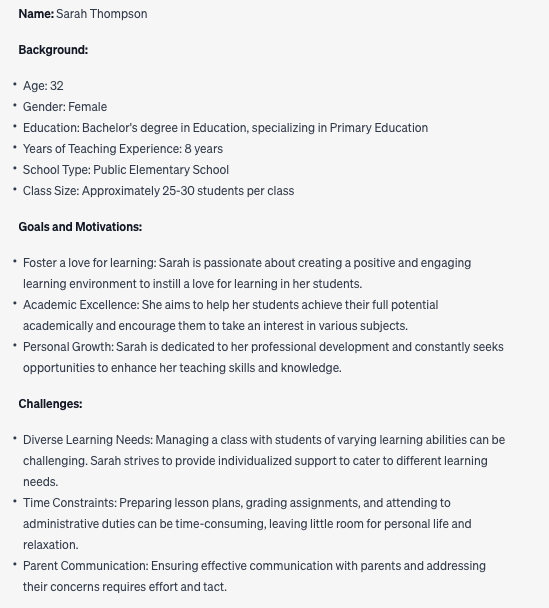
This is a great example of where a human needs to step in after utilising what AI has to offer. It’s a great starting point, and will save valuable time in starting the customer persona profiling, however, it needs the input of a human to expand upon the points and map all the ‘other Sarah’s’. With customer persona profiling, there is not a one size fits all approach. As humans, we understand empathy and much more than just ‘the norm’.
Automating repetitive tasks
When I started my career, I was in charge of managing social media accounts. This was a timely process and meant that my time was mostly spent thinking of ideas, designing graphics and scheduling. AI automation undoubtedly brings efficiency by handling repetitive tasks such as email marketing, social media scheduling, and data analysis. This enables junior marketers to focus on higher-value activities, such as content creation, strategy development, and fostering customer relationships. It is my belief that by utilising AI to carry out the repetitive tasks, this means junior roles can become more strategic and innovative. This therefore should ensure that career progression is a quicker and less time intensive process. Junior roles are learning quickly what it means to think strategically.
Reporting and refining
AI’s predictive capabilities can significantly impact marketing campaigns’ success by analysing data and identifying patterns. This means that you can utilise what technology has to offer in order to optimise your campaigns and refine your strategies based on real-time data. However, it still requires human oversight and creativity to set marketing objectives, design strategies, and interpret campaign outcomes. Junior marketers can leverage AI-generated insights to refine their strategies and make more informed decisions, enhancing the overall campaign performance. Platforms such as Domo are changing the landscape of reporting, and I believe this is for the better. It means that marketing teams can streamline their processes and enables junior roles to understand what goes in to weekly, bi-weekly or monthly reporting.
So to answer the question ‘is AI really going to take my job?’ No, I don’t think so. I believe marketers should utilise the technologies that are being handed to them. Marketing is a fast-paced industry with constant changes. Twitter has just become X! So by keeping on top of all the changes in the digital world, I think this will only empower junior marketers to climb up the career ladder at a greater pace and enable companies to make data-driven decisions to enhance campaigns and strategies.
What do you think though?