
As if SEO wasn’t confusing enough, recently the world has opened up new terms related to SEO. There’s nowSEO, AEO and GEO. Throw in LLMO, AIO, and GSO for good measure, and it’s starting to feel less like marketing strategy and more like someone tipped a Scrabble board onto a strategy deck.
So we’ve decided enough is enough and we’re going to cut through the noise.
SEO, AEO, and GEO are three layers of how your business gets found online in 2026, and understanding the difference between them isn’t optional anymore. It’s the difference between showing up and being invisible.
SEO: The One You Already Know
Search Engine Optimisation (SEO) has been the bread and butter of digital marketing for two decades. You write content, optimise it for the words your audience is searching, write really good meta descriptions and headings, you earn backlinks and then Google rewards you with rankings. People then click and you win.
That fundamental mechanic hasn’t changed. What has changed is how much of the search results page Google now fills with its own features. Think AI Overviews, featured snippets, People Also Ask boxes, knowledge panels. The organic blue links are still there, but they’re further down the page than they used to be, and they’re competing with AI-generated summaries that answer the question before anyone needs to click.
Is SEO Still Relevant?
Yes, absolutely! SEO isn’t dead. Far from it in fact. Google still commands the vast majority of search traffic globally (90.02% as of May 2026), and the content that ranks well in traditional search is overwhelmingly the same content that AI tools pull from when they generate answers.
Strong SEO is the foundation everything else is built on. Without it, AEO and GEO don’t have anywhere to stand. In fact, we have the evidence to back it up.
Our in-house SEO magician, Hannah Hall, optimised our “edtech marketing” page a while back, before we entered the ‘what the f***EO era’. It ranks organically, and it appears in AI overviews.

And we get referral traffic from different LLMs:
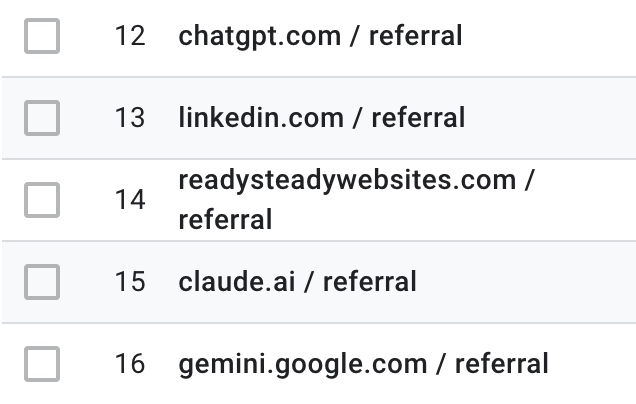
We haven’t tried to manipulate this page in any particular way. We’ve just tried to make it as useful as possible, and really thought about who our audience is and what they’d like to know.
These days, you’d technically call that an AI ‘query fan out’ approach. But to us, it’s just how we approach thinking about our audience and their intent.
If your website is technically sound (and here’s Google’s guidance on technical requirements) loads quickly, has clear heading structures, earns quality backlinks, and answers the questions your audience is actually asking, you’re already doing the work that matters most. Don’t let ANYONE convince you to abandon that. And if they do, run for the hills.
AEO: Optimising for Answers, Not Just Rankings
Answer Engine Optimisation (AEO) is where things start to shift. AEO is the practice of structuring your content so that AI-powered platforms, like Google’s AI Overviews, ChatGPT, Perplexity, Copilot, Claude etc, can find it, understand it, and serve it up as the direct answer to someone’s question.
With traditional SEO, success meant getting someone to click. With AEO, success might mean your content gets cited in an AI-generated answer even if the person never visits your website. That’s a big mental shift for marketers who’ve spent years obsessing over click-through rates.
The numbers behind this shift are hard to ignore. Roughly 60% of Google searches now end without a click. ChatGPT alone has over 900 million weekly active users. Now add to this, Gartner has predicted that traditional search volume will drop by 25% by the end of 2026 as people move towards AI assistants, it’s all a bit of a weird shift in the world of marketing. Whether those exact figures land precisely is almost beside the point, but the direction of travel is clear.
So What Does AEO Actually Look Like in practice?
Well, some would argue there are certain things you can do to make AI answers more likely to cite you.
For example, you could try writing content that gives clear, concise answers near the top of sections. Other methods that AI models seem to prefer include:
- Using question-based headings that mirror the way people actually ask AI tools for help. It means:
- Implementing structured data (schema markup) so machines can parse your content without guessing
- Making sure every key claim on your site is independently understandable, not buried in a 2,000-word essay where the AI has to work out which sentence is the actual answer
Think of it this way: SEO gets you onto the pitch. AEO makes sure the commentator actually mentions your name.
With that said, in May 2026, Google dropped some official guidance saying that AEO, GEO (and wtfeo) are just SEO. Yep, they’re saying there aren’t any quick wins or ways to trick the system. Instead, you should just focus on strong SEO fundamentals, and that going “beyond common knowledge and the ordinary” is the way to get yourself seen.

For now, the jury is out on this. Google has historically said there are things you should and shouldn’t do. But as SEOs, our job is to test these. We can’t just take their word verbatim! Testing, checking the data and refining is, without a doubt, the best way to find what works.
GEO: The Newest Kid on the Block
Generative Engine Optimisation (GEO) takes things a step further again. If AEO is about being the answer, GEO is about being the source that AI chooses to trust, cite, and recommend when it’s building those answers from scratch.
The term was popularised by a Princeton University research team studying how AI models select and surface sources. Their findings showed that adding expert quotes to content could boost AI visibility by around 40%, and that statistics and citations delivered similar lifts. In other words, the more authoritative and evidence-based your content, the more likely AI tools are to lean on it.
GEO recognises that AI doesn’t just scan your website in isolation. It cross-references you against everything else it can find:
- Your LinkedIn profile
- Third-party reviews
- Industry publications
- Directory listings
- Even Wikipedia entries
If your brand shows up consistently across multiple credible sources saying the same thing, the AI gains confidence and is more likely to cite you. If your website says one thing and your Google Business Profile says another, the AI loses trust and may skip you entirely.
This is why entity consistency matters so much. Your brand name, your services, your location, your key claims all need to match EVERYWHERE. It’s the kind of boring, unglamorous housekeeping that rarely makes it onto a strategy slide, but it’s one of the single biggest levers for AI visibility.
Again, we need to take this with a grain of salt given the Google guidance. And yes, this is just Google’s guidance. Other search engines and AI models will have different ways of doing things. So we still need to be mindful of GEO and AEO, yet always keeping the motto of “Go beyond the ordinary” and strong SEO fundamentals as the foundations of everything you do.
How SEO, AEO, and GEO Actually Work Together
Here’s the good news: these aren’t three separate strategies. They’re layers with each one building on the last. We know marketers may be capitalising on the opportunity to bill for three separate services, but that’s not how we roll at Conv3rt. We believe it should be a holistic approach.
- SEO is your foundation. It gets your content indexed, ranked, and visible to both search engines and the AI tools that crawl them.
- AEO is your formatting layer. It structures your content so AI platforms can extract clear answers and serve them to users.
- GEO is your authority layer. It builds the cross-platform credibility signals that make AI engines choose you over your competitors.
If you’re an SME or B2B brand, the practical takeaway is this: you don’t need three separate budgets or three separate agencies.
You need one coherent strategy that covers all three, starting with strong SEO fundamentals, layering in answer-first content structure, and building brand consistency across every platform where your audience (or their AI assistants) might encounter you.
And you need an authoritative voice. An influencer, so to speak. Someone who really is taking their thinking (and content) beyond the simple answer.

What Should You Actually Do About SEO/GEO/AEO?
If your head is spinning slightly, that’s fair. Here’s the short version of what matters right now.
First, don’t panic and don’t abandon your SEO. It still works. AI tools rely heavily on search-indexed content, so the better you rank, the more likely you are to be cited.
Second, start thinking about how your content is structured. Are you answering questions clearly and concisely? Are your headings doing the heavy lifting? Could an AI read your blog post and pull out a clean, usable answer without wading through five paragraphs of preamble?
Does your internal linking system clearly build topical authority around key areas? (This one is so powerful, yet so underutilised) If not, that’s your next job.
Third, audit your brand presence across the web. Google your business name and see what comes up. You could even ask your AI model of choice what it thinks of you. Check your schema markup. Make sure your LinkedIn, Google Business Profile, directory listings, and website are all singing from the same hymn sheet. Consistency is the new authority.
And fourth (this one’s free), go and ask ChatGPT or Claude a question about your industry. See who comes up in the answer. If it’s not you, you’ve got work to do.
The Next Steps For You and What the f***EO
The marketing industry loves a new acronym. And yes, “What the f*** EO” is a perfectly reasonable response to watching three more letters get added to your to-do list. But behind the jargon, the principle is actually quite simple: make your content genuinely useful, value adding, easy to find, and easy to trust. Simple, right? (‘No’ is still a perfectly valid answer here, by the way!)
Do that consistently, and whether the algorithm serving it up is Google’s, ChatGPT’s, or whatever comes next, you’ll be in the answer.
And being in the answer is the only EO that really matters.
Not sure where to start with your SEO, AEO, or GEO strategy? Conv3rt helps SMEs and B2B brands build search visibility that actually works, across every platform your audience uses to find answers. Get in touch for a no-obligation chat about your journey with organic search.
Note: We wrote this in May 2026, when these facts were fresh and correct. As you’ll probably know, Google regularly updates its algorithms, and things can literally change overnight. We’ll try our best to keep this current, but please do reach out to us if you’re reading this and it feels outdated.